Why Your Coding Productivity Gains May be Building a Time Bomb
Key Takeaways:
1. Productivity gains are real—but context-dependent. AI coding tools deliver 55-100% speed improvements on isolated, well-defined tasks. But in complex existing codebases, a 2025 study found developers were 19% slower with AI—while believing they were faster. Match your expectations to the work type.
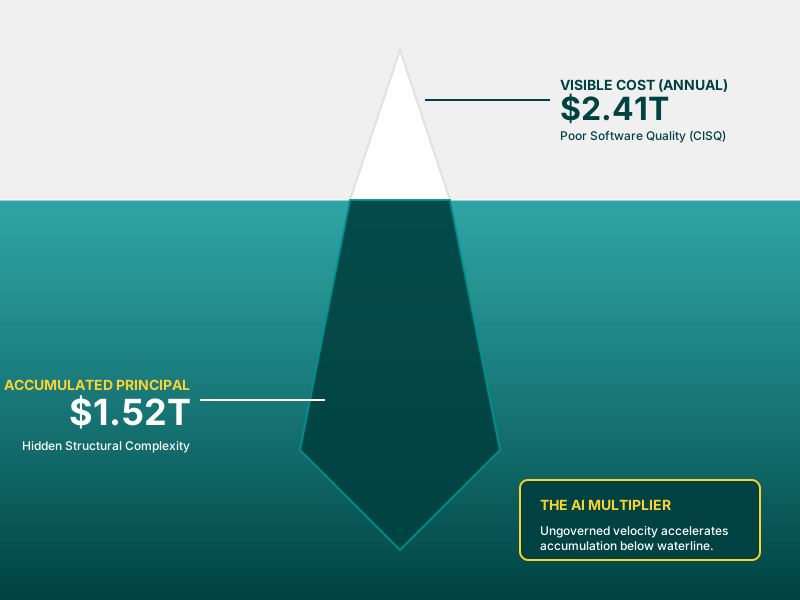
2. Speed without governance creates compounding costs. AI-generated code carries a “higher interest rate” on technical debt that’s harder to detect and fix. With U.S. software quality costs at $2.41 trillion annually and most organizations allocating less than 20% of budgets to address debt, the gap is widening.
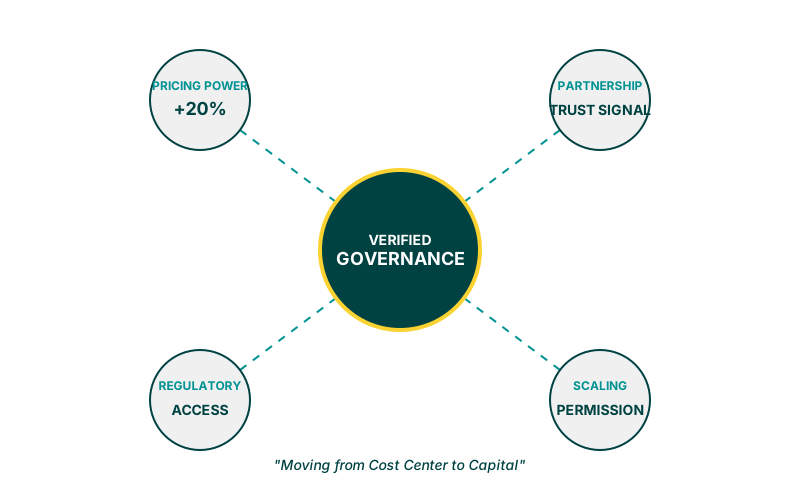
3. Governance is a competitive advantage, not overhead. Organizations with verified AI governance practices capture a measurable “Governance Dividend”: 20% pricing premiums, faster regulatory access, accelerated partnerships, and the ability to scale beyond pilots. The winners won’t be fastest or slowest—they’ll be most deliberate.
Last quarter, during a strategy meeting, someone asked the question I’d been avoiding: “We’ve deployed AI coding assistants across dev teams. Velocity metrics look strong. So when do we start seeing the efficiency gains translate into resource optimization?”
The room went quiet. Or maybe it just felt that way to me.
I realized I didn’t have a good answer—because I’d been celebrating the wrong metrics. We had dashboards showing faster pull requests, higher commit volumes, impressive time-to-completion numbers. What we didn’t have was clarity on what we were building underneath all that speed.
That question sent me down a research path that changed how I think about AI-assisted development. And what I found was sobering: we’re not alone in confusing velocity with value.
Every January, I publish my AI trends forecast here on AiExponent. This year, I want to do something different. Instead of surveying the landscape, I want to go deep on one trend that I believe will define 2026 for technology leaders: the reckoning between AI velocity and system integrity.
This isn’t a warning against AI adoption. The productivity gains are real, and in many contexts, substantial. But it is a call for strategic discipline—the kind of discipline that separates organizations who capture lasting value from those who discover, too late, that speed without governance creates costs that compound silently.
The Productivity Numbers Are Real—And That’s Important
Let me start by acknowledging something clearly: AI coding tools deliver genuine productivity gains in many contexts. The evidence is substantial.
These aren’t vendor marketing claims. They’re peer-reviewed findings from credible institutions. The immediate benefits are real, and dismissing them would be intellectually dishonest.
But here’s where the picture gets more complicated.
In July 2025, METR published a study that introduced important nuance. They gave experienced developers—people with an average of five years on their codebases—real tasks in their own repositories. Half were randomly assigned to use AI tools; half worked without them.
The result? Developers using AI were 19% slower. Not 19% faster. Slower. Even though they predicted AI would speed them up by 24%. Even though, after the study, they still believed it had helped.
The gap between perception and reality was 43 percentage points.
Understanding the Paradox: Context Is Everything
Before drawing conclusions, it’s worth understanding what these studies actually measured—and what they didn’t.
The productivity studies showing massive gains typically involve isolated, well-defined tasks. The METR study involved complex brownfield work in large codebases that developers already knew intimately.
I should note: the METR study had limitations. Sixteen developers is a small sample. The participants had “moderate” AI tool experience, not expert-level proficiency.
The honest answer is that AI coding tools appear highly effective for certain task types and less effective—potentially counterproductive—for others.
Where AI Genuinely Delivers
To be fair to the technology, let me acknowledge where AI-assisted coding is delivering clear value: boilerplate code, documentation, test generation, prototyping, and learning acceleration for junior developers.
These are real benefits that organizations should capture. The risk isn’t in using AI for these tasks—it’s in assuming the same productivity gains transfer uniformly across all development work.
The Risks We’re Underweighting
In August 2025, MIT Sloan Management Review published a piece by Anderson, Parker, and Tan using a financial analogy: technical debt. Their key insight: AI-generated code comes with a “much higher interest rate” and is “harder to fix and detect than traditional coding problems.”
According to CISQ, the total cost of poor software quality in the U.S. has reached $2.41 trillion annually. The accumulated technical debt principal stands at $1.52 trillion.
What the Aggregate Data Shows
Google’s 2024 DORA Report found that a 25% increase in AI adoption corresponds to a 7.2% decrease in delivery stability. GitClear’s analysis shows code duplication increased eightfold compared to two years earlier.
These patterns warrant attention, even if they don’t warrant panic.
The Human Factor
“With AI, a junior engineer writes as fast as a senior one, but without the cognitive sense of what problems they’re creating.” This is the developer experience gap.
But here’s the opportunity: organizations that recognize this gap can address it through deliberate practices. The gap is a problem only if it’s ignored.
The Governance Dividend
I call it the Governance Dividend—the measurable competitive advantage that accrues to organizations with demonstrable, verified AI governance practices.
“Governance isn’t a constraint on value creation. It’s the foundation for sustainable value creation.”
A Framework for Governed AI Development
1. Distinguish Vibe Coding from Production Coding
Culture Amp’s CTO Doug English distinguishes between “vibe coding”—AI-assisted exploration—and production coding. Vibe coding should be encouraged but should never make it to production without transformation.
2. Make Technical Debt Visible and Owned
Technical debt needs to become a core metric—tracked with the same rigor as revenue. Senior engineers need to evolve into AI coaches.
3. Invest in Documentation as Strategic Infrastructure
The 2023 DORA Report found documentation has an almost 13-fold impact on organizational performance. Morgan Stanley’s DevGen.AI has processed over 9 million lines of legacy code—using AI to reduce technical debt, not accelerate its accumulation.
A View from the Middle East
The UAE’s approach offers lessons: we’re not choosing between speed and governance—we’re treating them as complementary. The UAE’s Law No. 3/2024, the AIATC, and the June 2024 AI Ethics Charter represent governance infrastructure built while the technology is still being deployed.
At national scale, we’re trying to move fast and build things—things that will last.
The Choice Ahead
I’m not arguing against AI coding tools. I’m also not arguing that speed is bad. Startups, MVPs, competitive windows—these may reasonably prioritize speed.
What I am saying is that context matters. The organizations that thrive won’t be those that moved fastest or slowest. They’ll be those that moved most deliberately.
That’s the Governance Dividend. And in 2026, the window to capture it is still open.
I'm Ajay Pundhir, a Senior AI Business Leader on a mission to architect a human-centric AI future. I share insights here to help leaders build responsible, sustainable, and value-driven AI strategies.