A recent study by PwC revealed that 73% of companies are already integrating Artificial Intelligence into their operations or planning to do so. The projected boost in productivity and efficiency is staggering, with McKinsey predicting AI could potentially deliver an additional $13 trillion to the global economy by 2030. But here’s the catch: merely adopting AI doesn’t guarantee success.
Like any transformative technology, AI integration comes with its share of pitfalls. Misaligned strategies, insufficient data infrastructure, a lack of talent, or ethical oversights can turn this promising tool into a costly experiment. The difference between a company that thrives in the AI era and one that flounders often boils down to readiness.
This is where a comprehensive AI readiness assessment can help you. With this framework, you can understand your strengths, weaknesses, and improvement areas by systematically evaluating your organization across 5 key pillars – strategic alignment, data infrastructure, talent and culture, operational processes, and ethical considerations.
This article will provide you with a robust 5-pillar Artificial Intelligence Readiness Assessment framework to help you embark on a successful AI journey.

AI Readiness Assessment Framework Pillar 1: Strategic Alignment – Your North Star for AI Success
“AI for the sake of AI” is a recipe for wasted resources and disillusionment. Companies that link AI initiatives to clear business goals are three times more likely to achieve significant value from their investments.
A robust AI strategy isn’t about following the latest trends but aligning AI capabilities with your unique value proposition and organizational goals. Below are the three factors to consider while aligning strategy for AI Integration.

Define Your AI Use Cases
The purpose of AI integration is not just to add AI into your processes or tech stack but to solve real-world problems and add value to the customer. This is where use cases with clearly defined value addition by AI is a must. Let’s see the real-world stories:
- Real-World Success Story: Predictive Maintenance at Siemens: Siemens, a global industrial manufacturing leader, implemented an AI-powered predictive maintenance system for its gas turbines. By analyzing sensor data and historical performance records, the AI model can accurately predict potential equipment failures before they happen. This allows Siemens to schedule maintenance proactively, reducing downtime by up to 10% and saving millions of dollars annually. This success underscores the power of a well-defined use case that aligns AI capabilities with critical business needs.
- The Peril of Undefined Use Cases: IBM Watson’s Healthcare Stumble: IBM Watson’s foray into healthcare provides a cautionary tale. While initially hailed as a revolutionary tool for cancer diagnosis and treatment, Watson faced challenges due to a lack of clearly defined use cases. The AI system struggled to integrate with existing healthcare workflows and failed to consistently deliver accurate diagnoses. This misalignment between AI capabilities and the complexities of healthcare resulted in setbacks and a loss of momentum for the project.
These are just a few examples. The key is to identify use cases where AI can solve your most pressing challenges or unlock new opportunities, directly contributing to your bottom line.
Leadership Buy-in
Harvard Business Review emphasizes that AI transformation requires strong leadership commitment. C-suite executives need a firm grasp of AI’s potential, its associated risks, and the resources needed for successful implementation. They should be active champions of AI initiatives, fostering a data-driven culture throughout the organization.
Key Questions you need to ask for Strategic Alignment:
- Does our company have a clear AI vision statement that aligns with our broader goals?
- Have you identified 2-3 specific use cases where AI can deliver measurable business value?
- Does our leadership team actively champion AI initiatives, fostering a data-driven culture?
Answering these questions honestly will lay the groundwork for a strategically sound AI journey, one that avoids costly missteps and positions your company to reap the full rewards of this transformative technology.
AI Readiness Assessment Framework Pillar 2: Data Infrastructure – The Foundation of AI Success
Think of data as the lifeblood that fuels AI’s engine. Algorithms are only as good as the data they learn from. If your data is inaccurate, incomplete, or inaccessible, your AI initiatives will falter.
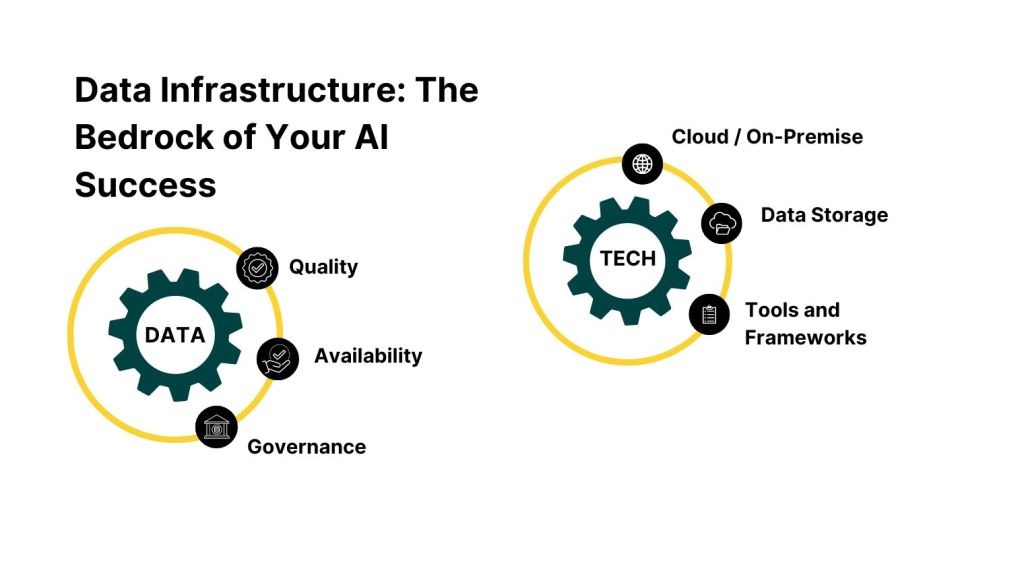
Assess Your Foundation
Data Quality: Clean, accurate, and well-structured data is the must of effective AI systems. According to MIT Technology Review, poor data quality can cost businesses an average of 20% of their annual revenue. It’s crucial to address issues like missing values, errors, and inconsistencies before embarking on AI projects.
Data Availability and Accessibility: Evaluate your data sources. Do you have the right data for the AI use cases you’ve identified? Is it siloed across different departments, or is it readily available? Breaking down data silos and establishing a centralized data repository is often a prerequisite for successful AI implementation.
Data Governance: A robust data governance framework is essential for ensuring data privacy, security, and ethical use. This includes adhering to regulations like GDPR, implementing security protocols, and establishing clear guidelines for data handling.
Technology Choices
Cloud vs. On-Premise: Consider factors like scalability, cost-effectiveness, and flexibility when deciding whether to store and process your data in the cloud or on your servers.
Data Storage and Processing Tools: Depending on your specific needs, you may need to invest in data warehouses, data lakes, or big data platforms to manage and analyze large volumes of data efficiently.
Key Questions you need to ask for Data Infrastructure:
- Do we have sufficient volume and diversity of data to train accurate AI models?
- Are our data collection, cleaning, and labeling processes well-defined and reliable?
- Do you have a robust data governance policy addressing privacy, security, and ethical considerations?
- Does our IT infrastructure support the storage, processing, and accessibility needs of AI initiatives?
By thoroughly evaluating your data infrastructure, you’ll gain a clear understanding of its strengths and weaknesses, enabling you to make informed decisions and invest in the right areas to ensure your AI projects have a solid foundation.
AI Readiness Assessment Framework Pillar 3: Talent and Culture – The Human Engine of AI Transformation
AI isn’t just about algorithms and data; it’s about people. Having the right talent in place and fostering a supportive culture is crucial for AI adoption to succeed.
Demystifying AI Expertise
- Data Scientists: These are the architects of AI, designing and developing models to extract insights and predictions from data.
- Machine Learning Engineers: They bridge the gap between research and application, ensuring that AI models are deployed efficiently and effectively in real-world environments.
- AI-Savvy Business Leaders: These individuals understand the business implications of AI and can champion projects, ensuring alignment with strategic goals.

Building Your AI Team
Acquiring AI talent can be challenging in today’s competitive market. It’s essential to consider a multi-pronged approach:
- Hiring New Talent: While this is often necessary to bring in specialized skills, it’s also important to be realistic about the cost and competition.
- Upskilling Existing Employees: Investing in training programs can help your current workforce develop AI competencies, which is often more cost-effective and can boost morale.
Cultivating an AI-Ready Culture
Deloitte emphasizes that a culture that supports AI experimentation is paramount. This means:
- Culture of Experimentation: Encouraging a “fail fast, learn fast” mentality, where data-driven experimentation is the norm.
- Data-Driven Mindset: Fostering data literacy at all levels of the organization, so that everyone understands the value of data and can use it to make informed decisions.
- Embracing Collaboration: Breaking down silos between IT, data science teams, and business units is crucial for aligning AI initiatives with business objectives.
Key Questions you need to ask for Talent and Culture:
- Do you have in-house data scientists, machine learning engineers, and domain experts with AI understanding?
- Do you have a plan to attract, develop, and retain AI talent?
- Does your company culture encourage a data-driven approach and tolerate the potential for failure during AI experimentation phases?
- Are there mechanisms in place to facilitate collaboration between technical and business teams?
By focusing on both talent acquisition and cultural transformation, you’ll create an environment where AI can thrive, leading to innovation and long-term success.
AI Readiness Assessment Framework Pillar 4: Operational Processes – Making AI Work for You
Developing an AI model is just the first step. The real challenge lies in seamlessly integrating AI into your daily operations so that it consistently delivers value. This requires careful planning and a deep understanding of your existing processes.
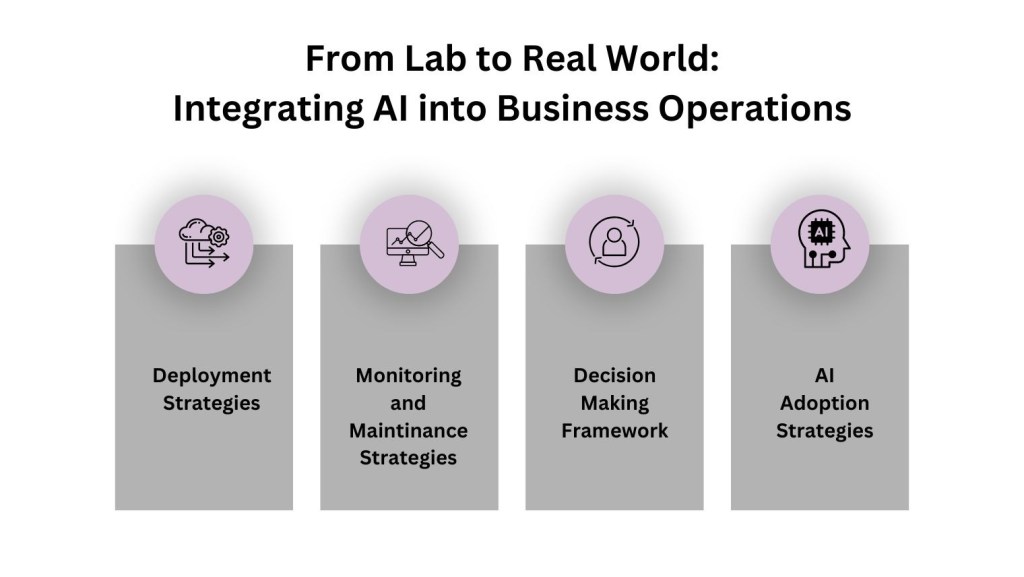
Model Deployment and Maintenance
AI isn’t a “set it and forget it” solution. Models need constant monitoring and maintenance to ensure optimal performance.
- Deployment Options: Consider whether to deploy your AI models in the cloud for scalability or on-premise for tighter control. Decide between batch processing for bulk analysis or real-time processing for immediate decision-making.
- Model Monitoring: Implement robust monitoring mechanisms to detect model degradation over time. Concept drift, where the real-world data starts to deviate from the data used for training, is a common issue that requires regular model retraining.
Rethinking Decision-Making
AI can transform decision-making processes, but it’s essential to determine the right balance between human and machine input.
- Human-in-the-Loop: In many cases, AI should serve as a powerful advisor, providing insights and recommendations, while humans retain ultimate decision-making authority.
- AI-Driven Automation: For routine or repetitive tasks, AI can make decisions autonomously, freeing up human resources for more complex activities. However, transparency and safeguards are crucial to ensure accountability and avoid potential biases.
Change Management for AI Acceptance
Introducing AI into the workplace can cause anxiety among employees. Proactive change management is essential to foster acceptance and trust.
- Communication and Transparency: Communicate the benefits of AI and how it will impact workflows. Address concerns about job displacement and emphasize how AI can augment, not replace human capabilities.
- Training and Upskilling: Invest in training programs to equip employees with the skills needed to work effectively alongside AI systems.
Key Questions you need to ask for Operational Processes:
- How will you deploy AI models and ensure smooth integration with existing systems?
- Do you have processes/tools to monitor AI models in production to ensure continued accuracy?
- Have you defined how decision-making will work – will AI support humans, or will it make certain decisions automatically?
- Do you have a change management plan to foster employee acceptance and trust in AI?
By addressing these operational considerations, you’ll create a clear roadmap for incorporating AI into your day-to-day operations, maximizing its impact, and ensuring a smooth transition.
AI Readiness Assessment Framework Pillar 5: Ethical Considerations – The Moral Compass of AI
Ethics must be an integral part of your AI strategy. Failing to address ethical considerations can result in unintended consequences, harm to individuals or groups, and damage to your organization’s reputation.
Algorithmic Bias & Fairness
AI models can inadvertently perpetuate or even amplify existing biases if trained on biased data. This can lead to discriminatory outcomes, particularly in areas like hiring, lending, and criminal justice.
- Sources of Bias: Biases can be embedded in historical data or arise from the limitations of the algorithms themselves.
- Mitigation Techniques: Strategies like balancing datasets, using debiasing techniques, and incorporating fairness metrics into model evaluation can help reduce bias.
Transparency & Explainability
Many AI models are considered “black boxes,” meaning their decision-making processes are opaque. This lack of transparency can erode trust and make it difficult to diagnose problems.
- Explainable AI (XAI): XAI methods aim to make AI decision-making more transparent and understandable to humans.
- Transparency around Data and Models: Documenting the data sources and algorithms used to build AI models is essential for accountability and trust.
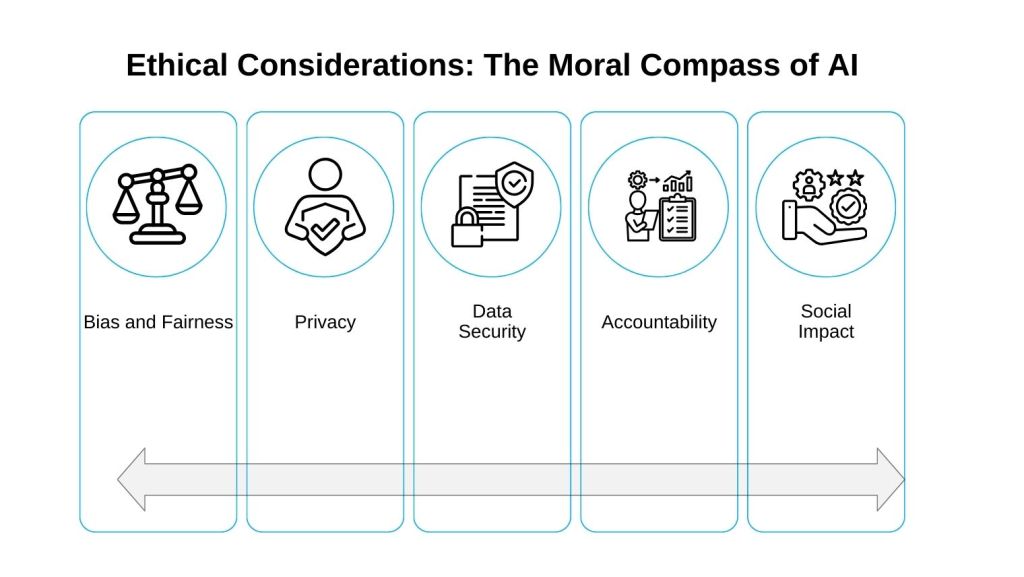
Accountability and Responsibility
Organizations must take responsibility for the decisions made or influenced by their AI systems.
- Clear Ownership: Establish clear lines of responsibility for AI-related decisions. Who is accountable if something goes wrong?
- Auditing and Oversight: Regularly audit AI systems for fairness, bias, and compliance with ethical guidelines.
Key Questions you need to ask for Ethical Considerations:
- Do you have processes to identify and mitigate potential biases in our AI models?
- Can you explain how our AI models arrive at their decisions?
- Have you defined clear lines of responsibility and accountability for the outcomes of our AI systems?
- Are you committed to ongoing monitoring and auditing of our AI systems to ensure ethical use?
By prioritizing ethical considerations, you’ll ensure that your AI initiatives are not only effective but also fair, transparent, and accountable.
Further Guidance:
Ethical considerations in AI are constantly evolving. To stay informed and make the most responsible choices, consult resources like the Montreal Declaration for Responsible Development of AI and frameworks released by organizations like Google AI Principles and the EU’s Ethics Guidelines for Trustworthy AI. These provide in-depth guidance on navigating the complex ethical landscape of AI.
AI Readiness – A Journey, Not a Destination
AI readiness isn’t a one-and-done checklist; it’s an ongoing process of assessment, improvement, and adaptation. As your organization and the AI landscape evolve, so too must your approach to AI integration. By utilizing the comprehensive framework we’ve explored, you can:
- Identify Your Strengths: Recognize the areas where your company is well-positioned for AI success, leveraging your existing assets and capabilities.
- Pinpoint Areas for Growth: Identify areas that need improvement across the five core pillars – strategy, data, talent, processes, and ethics.
- Prioritize Your Efforts: Develop a strategic roadmap for AI initiatives, focusing on the most impactful areas for improvement to maximize potential gains.
The transformative potential of AI is immense. Organizations that proactively assess their readiness and strategically address gaps are better equipped to harness this power. By taking the steps outlined in this framework, you’re not only preparing for AI adoption but positioning your company to thrive in the AI-driven economy.
“The future of AI is not about replacing humans; it’s about empowering them.”
Remember, AI is a tool, not a magic bullet. The organizations that will truly succeed are those that approach AI with a clear strategy, a strong foundation, the right talent, adaptable processes, and an unwavering commitment to ethical principles. Take the first step today and ensure your organization is not just AI-ready, but AI-thriving.