LitmusAI
Version v1.2.1Screens any AI system description against the EU AI Act Article 5 prohibitions and returns per-category Red / Amber / Clear verdicts with regulatory citations, confidence levels, and remediation guidance. It screens all ten Article 5(1) prohibitions, including points (ba) and (bb). Conservative-by-default: prefers Amber over Clear on ambiguity. UNREVIEWED reference ruleset; signed BYO rulesets supported. Apache 2.0, zero network calls, runs entirely offline. The PyPI distribution is `litmus-screener` (the brand is "LitmusAI"; an unrelated `litmus-ai` package already exists on PyPI).
Install
bashpip install litmus-screenerNeeds Python 3.11 or newer.
Apache 2.0 · zero telemetry · source Regulation (EU) 2024/1689 (Article 5).
Verified run
LitmusAI, tested on public examples
175 worked examples of prohibited and permitted AI practices, with the expected answer for each written down before any run by a tester who never saw the rules. Sources: European Commission Guidelines on prohibited AI practices, C(2025) 5052; Regulation (EU) 2026/1744, recitals 12 to 14.
Full screen of each system.yaml
- Tested
- Version 1.2.0, 3 Nov 2026; same verdicts on 1.2.1
- Expected prohibitions found (Red)
- 49 of 51
- Flagged for review (Amber)
- 2 of 51
- Missed (Clear)
- 0 of 51
- Permitted examples screened Red
- 9 of 113
- Permitted examples screened Amber
- 29 of 113
Known limits
- The figures are for the full screen of a system.yaml. The quick screen (litmus screen --describe), which infers fields from a plain-text description, missed 27 of the same 51 expected prohibitions. Use it as a first look only.
- Points (a) and (b) are screened from your answers to the influence questions. A file that leaves them unanswered falls back to the earlier screen, which missed 6 of 7 on version 1.1.3.
- The 9 Red results on permitted examples are cases the rules do not model: accidental generation, emergency medical use and red-teaming for (ba) and (bb), proportionality for (c), and emotion recognition used only for a person's own training.
- The author of the 1.2.0 rules had seen the first run's results, and one tester wrote every declaration, so this is weaker evidence than a first run. The Commission's guidelines are non-binding, and worked examples are not real deployments.
The recorded run
$ verification/run.sh --no-docker
litmusai 1.2.1
ruleset_version: ruleset-2024-1689-v1.2
ruleset_legal_status: UNREVIEWED
Screened 175 cases; 0 check(s) failed.
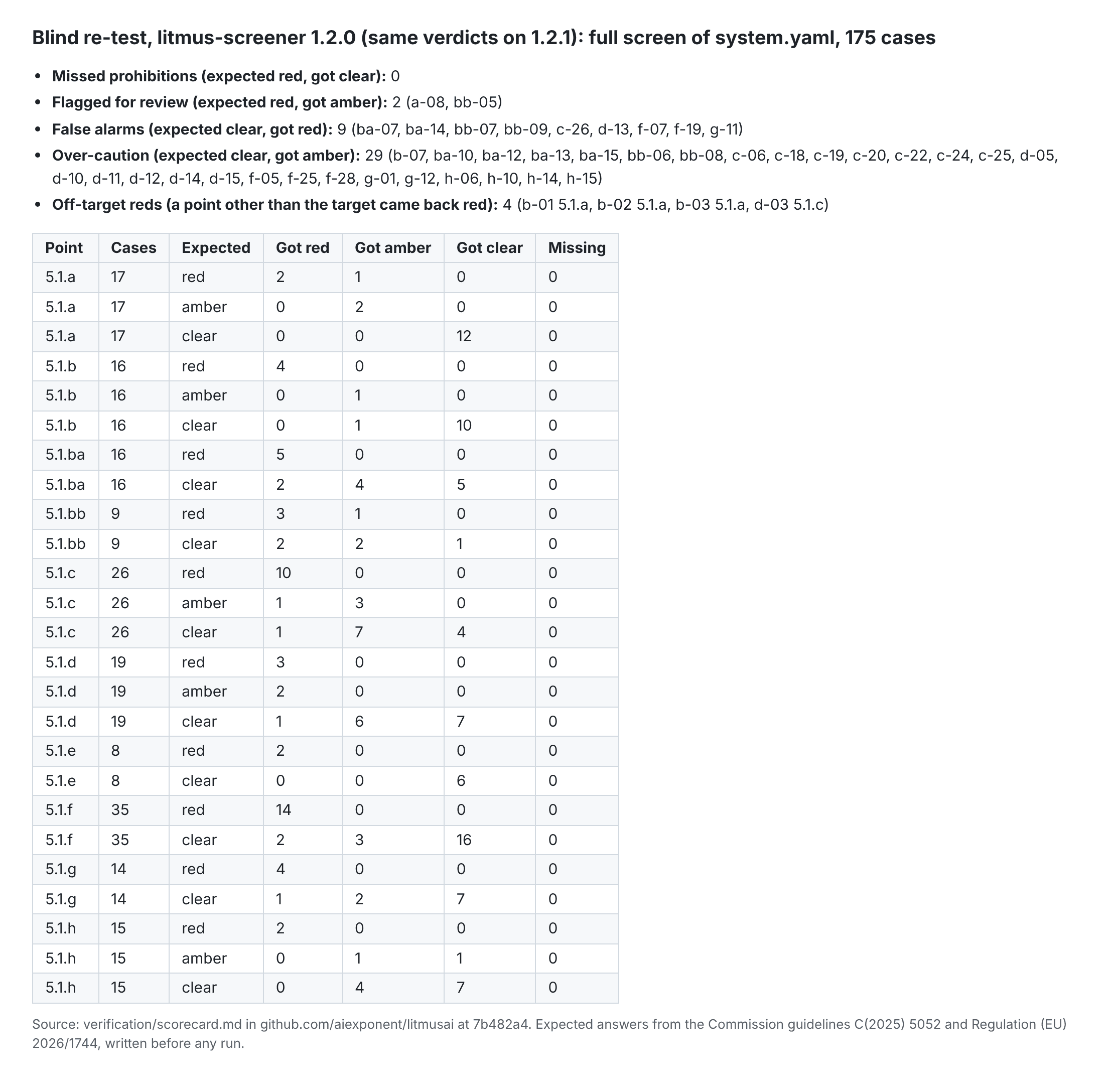
- **Missed prohibitions (expected red, got clear):** 0
- **Flagged for review (expected red, got amber):** 2 (a-08, bb-05)
- **False alarms (expected clear, got red):** 9 (ba-07, ba-14, bb-07, bb-09, c-26, d-13, f-07, f-19, g-11)
- **Over-caution (expected clear, got amber):** 29 (b-07, ba-10, ba-12, ba-13, ba-15, bb-06, bb-08, c-06, c-18, c-19, c-20, c-22, c-24, c-25, d-05, d-10, d-11, d-12, d-14, d-15, f-05, f-25, f-28, g-01, g-12, h-06, h-10, h-14, h-15)
- **Off-target reds (a point other than the target came back red):** 4 (b-01 5.1.a, b-02 5.1.a, b-03 5.1.a, d-03 5.1.c)
...
Verdicts match the published results.csv.
litmus-screener 1.2.1, captured 2026-11-04, on the 175 worked examples of the independent test (verification/ in aiexponent/litmusai). Trimmed for length; replay paced for display.
The scorecard and one output file
The scorecard counts every case of the run. The SARIF file is the real output of litmus-screener 1.2.1 for case f-06, checked against the OASIS SARIF 2.1.0 schema.
Scorecard of the 175 cases
SARIF tab: case f-06, a call centre tracking employees’ emotions, expected Red under Article 5(1)(f)
Article 5(1)(f)
the placing on the market, the putting into service for this specific purpose, or the use of AI systems to infer emotions of a natural person in the areas of workplace and education institutions, except where the use of the AI system is intended to be put in place or into the market for medical or safety reasons;
A screening result is evidence for your own review. LitmusAI is not a legal opinion, a conformity assessment or a certification.
Why LitmusAI exists
Prohibited AI practices
Article 5 has been applicable since 2 February 2025 (Art. 113(a)). It has been sanctionable under Chapter XII (Articles 99–100) since 2 August 2025 (Art. 113(b)). Placing or using a prohibited-practice AI system on the EU market today exposes the provider, importer, distributor, or deployer to the highest tier of fines in the regulation: up to €35M or 7% of global annual turnover, whichever is higher, under Article 99(3). Article 5(1) has no opt-out route: once a system meets a prohibition's criteria, including its stated exceptions, no mitigation after the fact makes it lawful. Regulation (EU) 2026/1744 adds two more prohibitions, points (ba) and (bb), which apply from 2 Dec 2026. For providers, they apply only where generating that material is the intended purpose, or a reasonably foreseeable outcome without adequate technical safeguards (Art. 5(1a)). Pre-deployment screening before code is shipped is the only defensible posture.
Other AiExponent tools